
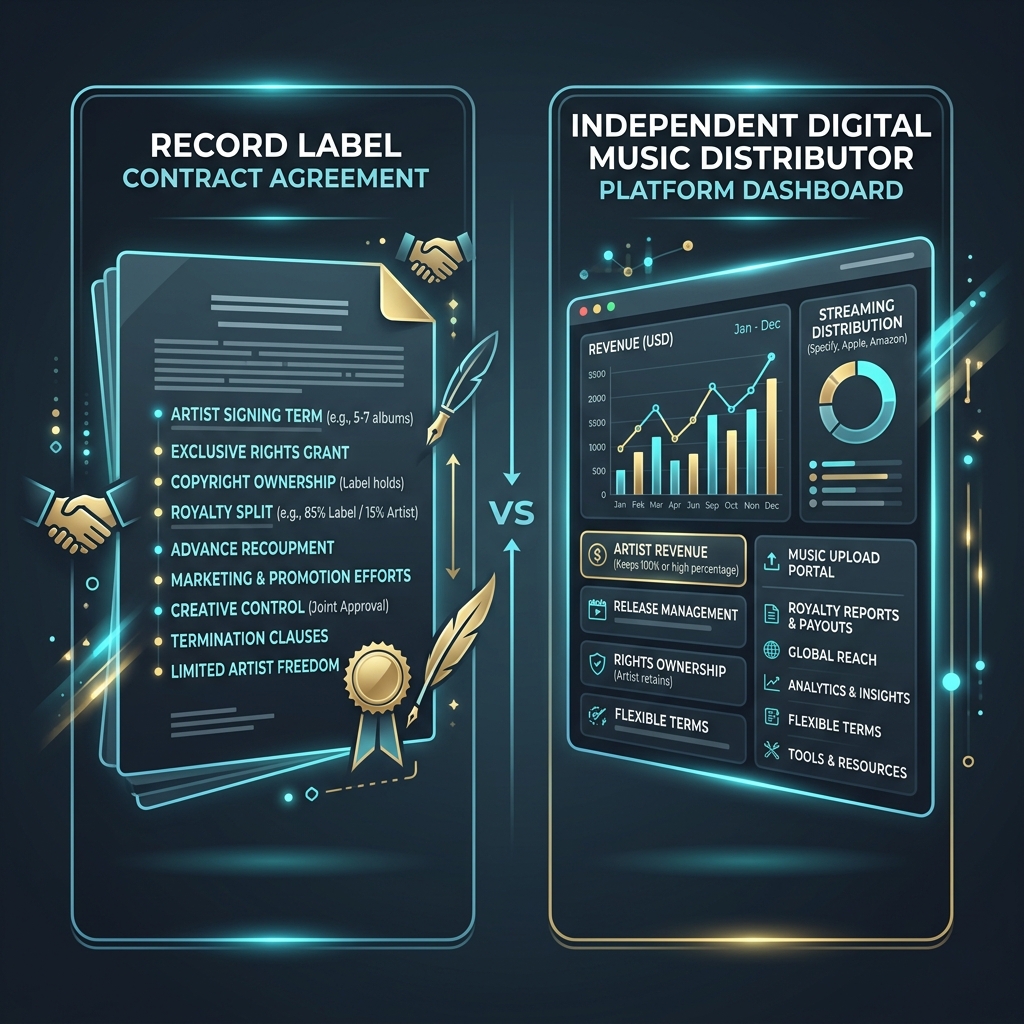
When launching a new project, every independent artist faces a crucial dilemma for their future: Should I sign with a record label or stick to a music distributor? Understanding the difference and knowing the new hybrid models is the key to not compromising your catalog for life.
1. The Traditional Distributor: Autonomy but Solitude
A distributor (like Distrokid, Tunecore or CDBaby) is a technological tool. Its function is simple: upload your audio files to digital stores in exchange for a flat fee or a percentage of your royalties. However, the distributor does not invest capital in your marketing, does not design your music videos, does not connect you with top-level producers or does public relations work for your songs. You are completely alone in the market.
2. The Traditional Record Label: Capital but Loss of Control
An old-school record label offers all the support that a distributor lacks: investment in production, massive radio campaigns, cinema-quality videos and a dedicated management team. The big problem is the cost of that infrastructure: they require full ownership of your songs (masters) for life and pay you minimum artistic royalty percentages (usually between 15% and 20%), first recovering each dollar invested from your own income.
3. The 1M Music Hybrid Model: The best of both worlds
At 1M Music we broke with this obsolete scheme. We created a structure that combines the power of a boutique label with the total freedom of an independent artist.
How does it work? We provide you with real investment capital, Grammy-winning mixing engineers, a dedicated strategic marketing team and 360° management. In return, we don't own your music for life: we work under a transparent partnership with equitable royalty splits and allowing you to retain full ownership of your catalog.
Don't choose between the loneliness of a distributor or the trap of a traditional label. Get the label infrastructure with the freedom of the independent by applying to the exclusive 1M Music roster today.